Tuesday, March 29, 2011

whale observation lab

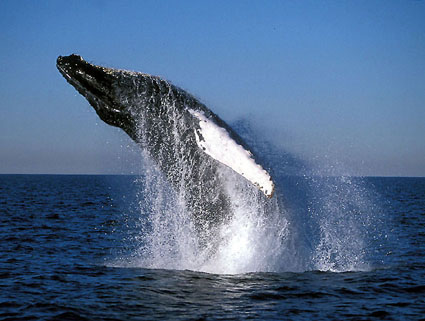
Introduction: over to past 10 years thousands of humpback whales have been hunted for the resources. japan and Norway alone kill over 1500 whales every year. because whaling is outlawed i'm wondering if the amount of whale population has gone up or down.

Question: is there more whales at the beginning of the session or at the end of the session?


Hypothesis: the amount of whales killed might still be high today so there would be more whales at the beginning of the session.


Prediction: If the number of whales hunted go up then there will be more whales at the beginning of the session.


Materials:

pen/ pencil

data sheet

clinometer


Procedure:

you will need to find your elevation from sea water with a GPS.

then you will take your clinometer and aim at a whale. the angle of the clinometer will help judge the distance from the whale. you will take to angle and put it into a formula: D= elevation X tan (angle.


Data: at the beginning of the session i spotted an estimated 5 whales from shore. at the end of the session i was not able to go to the whale watch, but friends let me use the data they found. it turns out that they spotted an estimated 7+ whales.


Conclusion: i hypothesized that there would be more whales at the end of the session, but my data clearly shows that there where more whales at the end of the session then at the end of the session. there may have been some sources of error. when we where spotting whales at shore we might have miss counted the amount of whales, and since i was never at the whale watch i dont know the exact amount for sure.


over all it was a great time of good whale watching fun. although i wasnt able to go to the whale whatch its self i dont think it hinders my ability to understand the whales. after all we will in hawaii.

Wednesday, February 9, 2011


This is my wanted poster for advanced research topics (or science). This poster fetures two pictures of marie curie, a picture of what she discovered and a brief paragraph of her work. it took about 1 hour to make with a few edits. This poster will be demostrated by Stephen Smith on wedensday or on the following monday.


Thursday, January 27, 2011

clinometer


the clinometer is very simple to use! all you need to do is follow these simple steps!
1. find your elevation via the gps.
2. find an object.
3. look at that object through the hole in your clinometer.
4. have a friend note down the angle that the string is pointing to.
5. now plug the information you have into this formula: D= elevation x Tan( angle
6. now plug this into your calculator and BLAMO! you have your distance!

Tuesday, January 25, 2011

whale watch at McGregor's point

the purpose of the whale watch for me was to see how many whales i can spot, then at the end of the year compare it to the number of whales i see at McGregor's. So is there more whale at the beginning of the year or at the end of the year? if whaling has gone down id think there would be more whales at the end of the year because at that time all the whales would be done traveling. the observation at McGregor's point was great. i think i saw 4 different pods, but i only recorded 2. it was very hard to see them because they where way of in the water, also the sun reflecting of the water was making it hard to see. all i saw was water spouts, no breaching sadly.

Tuesday, January 4, 2011

in this lab there are 9 marine phyla. these are porifera, cnidoria, mollussca, arthropoda, echino, nemotoda, prutyha, annelida and crustations. we will go to the tide pools and observe and count as many marine phyla as we can. we will use a quadrate and a transect line and count up all the creatures that are in our quadrate. we will count each creature and name them by there phyla.

are research question is which marine phyla are present at the tide pools and which one is there the most of. our hypothesis is the mollusk will be the most of any phyla at the tide pools. so we found out our hypothesis was true, but there may have been sources of error such as, re counting specimen, rising tides, creatures moving ect.

it was great fun geting out there in the pools. we got to see some amazing creatures like a puffer fish! it was also a good learning experience. it kept us thinking and i don't think anyone got bored.

Thursday, November 18, 2010

this is us discussing where we need to go
this is our first location!
again trying to find out where we need to go

our first location!